

Quick answer
The report hotels knew as Form C is now Form III under the Immigration and Foreigners Act, 2025, in force from 1 September 2025. Hotels and other accommodation providers must report the arrival and departure of every foreign guest online within 24 hours. OCI cardholders, earlier exempt from Form C, are now included.
If you search for Form C today, the government portal you land on is titled Online Form III. Its notice says all accommodators, hotels and educational institutes are legally obliged to fill Form II, formerly Form A, and Form III, formerly Form C, in respect of all foreigners, and that OCI cardholders, who were earlier exempt, are now included under the Immigration and Foreigners Act, 2025.[1] The Act has been in force since 1 September 2025, and it requires arrival and departure to be reported within 24 hours.[2] This article is general information, not legal advice.
What changed from Form C to Form III?
| Point | Earlier | Now |
|---|---|---|
| Name of the accommodation report | Form C | Form III |
| Governing law | Older statutes, including the Registration of Foreigners Act, 1939 and the Foreigners Act, 1946 | Immigration and Foreigners Act, 2025 (Act No. 13 of 2025) |
| OCI cardholders | Exempt from Form C and Form A | Included |
The 2025 Act replaced four older laws: the Passport (Entry into India) Act, 1920, the Registration of Foreigners Act, 1939, the Foreigners Act, 1946 and the Immigration (Carriers' Liability) Act, 2000.[2] For a front desk, the practical changes are the new name and the OCI rule. Staff who learned that OCI guests need no form should be told that this no longer holds.
Who has to file Form III?
The portal notice speaks of all accommodators, hotels and educational institutes.[1] A published summary of the Act lists hotels, guest houses, hostels and paying guest accommodation among those who must report.[2] If you run a small property, a homestay or a villa and host a foreign national, do not assume you are outside the rule. Register, or confirm your position with the local FRRO or a lawyer. Other points for small hosts are in homestay management software in India.
The notice names Form II alongside Form III. Read the portal's own instructions to see which form applies to your type of establishment.
What is the deadline?
Twenty-four hours. Arrival is reported within 24 hours, and departure is also reported.[2] The clock does not stop for weekends or for a busy shift. A guest who checks in at 11 pm on a Saturday needs a submitted form by 11 pm on Sunday. The safest rule is the simplest: file before the end of the shift in which the guest arrived.
How do you file Form III?
- Register the property once. Use the Sign Up option on the portal to create the property's account.[1]
- Enter the guest's details. Passport number, visa details, nationality and check-in date.[2]
- Submit within 24 hours of arrival.
- Keep the acknowledgement. Save or print it and file it with the stay record.[2]
- Update the check-out. When the guest leaves, record the departure on the portal.[2]
Two housekeeping points from the portal. It applies a 30-day password change policy, so a login that worked last month may not work tonight. And the notice says the portal is being migrated to a new Form III portal, so the address or screens may change.[1] Keep the login with more than one responsible person, and test it before a foreign guest is standing at the desk.
What should the front desk capture at check-in?
- Passport: number, nationality and the details page.
- Visa details. For OCI cardholders, the OCI card details.
- Arrival: date and time of check-in.
- Stay: room number and expected departure date.
- For every guest in the room, not only the person who made the booking.
Take these before handing over the key. Once the guest has gone out for the day, the 24 hours are already running. Check what the portal form asks for and match your registration card to it, so nothing has to be requested twice.
A routine that prevents missed filings
- Mark foreign and OCI guests on the arrivals list each morning, from the nationality on the booking.
- Make one named person per shift responsible for filing.
- File at check-in, not hours later.
- Attach the acknowledgement to the reservation or the registration card.
- At checkout, update the departure before closing the folio.
- Each night, compare the in-house list of foreign guests with the forms filed that day.
- Keep the records in a way you can produce on request. Ask your lawyer how long to retain them.
The nightly comparison fits naturally into the night audit.
What happens if a hotel does not file?
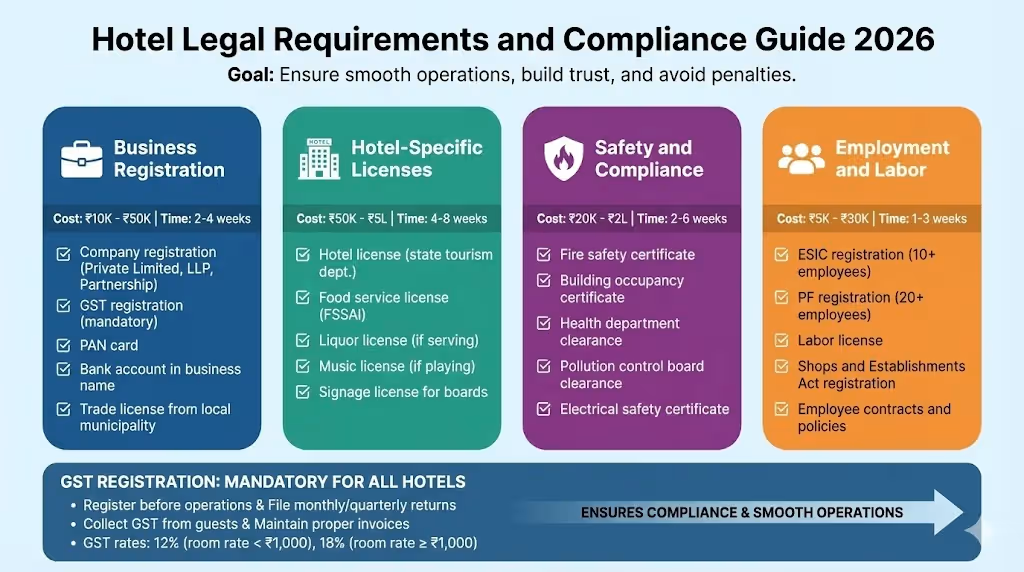
The Act provides for penalties. We do not quote a figure here. Amounts and how they are applied should be read from the text of the Act, and the summary we consulted says the same.[2] If you have missed filings, speak to a lawyer or your local FRRO office and correct the position instead of waiting. For the wider list of licences and registrations, see the hotel legal requirements and compliance guide.
Where RevNext fits
RevNext is hotel software and a managed revenue team, not a law firm, and it does not submit Form III for you. Filing is done by your staff on the government portal. What the Cloud PMS gives you is a guest profile linked to every stay and a front-desk dashboard of arrivals, in-house guests and departures, which is the list you check your filings against. It starts at Rs 3,999 a month plus GST; the suite of nine products is Rs 17,999 a month plus GST. See pricing.
Key takeaways
- Form C has become Form III. The government portal page is titled Online Form III.
- The Immigration and Foreigners Act, 2025 has been in force since 1 September 2025.
- All accommodators must file for all foreigners, and OCI cardholders are now included.
- Arrival and departure are each reported within 24 hours, online.
- Capture passport number, visa details, nationality and check-in date at the desk, before the guest goes to the room.
- Penalties exist. This article gives no figure: read the Act or ask a lawyer.
Last updated: 2026-11-16
Sources
The obligation and the inclusion of OCI cardholders were read on 16 November 2026 from the Bureau of Immigration's Online Form III portal notice. The Act's commencement date, the 24-hour window and the filing steps are from a published summary of the Act. This is general information, not legal advice.
- Bureau of Immigration, Ministry of Home Affairs, Online Form III portal notice
- RTI Wiki, Immigration and Foreigners Act 2025: Who Must Report
FAQ
What is Form C in a hotel?
Form C was the report a hotel filed with the immigration authorities for each foreign guest. Under the Immigration and Foreigners Act, 2025 it is now called Form III, and it is filed online through the Bureau of Immigration's portal.
Is Form C required for OCI cardholders?
Yes, now. The Online Form III portal notice says OCI cardholders, who were earlier exempt from the provisions of Form C and Form A, have been included under the Immigration and Foreigners Act, 2025.
Within how many hours must a hotel report a foreign guest?
Within 24 hours. The arrival is reported within 24 hours of check-in and the departure is updated on the portal when the guest leaves, also within 24 hours.
Do homestays and guest houses have to file Form III?
The portal notice refers to all accommodators, and a published summary of the Act lists hotels, guest houses, hostels and paying guest accommodation. A homestay hosting foreign nationals should register on the portal and confirm its position with the local FRRO or a lawyer.
What is the penalty for not filing Form III?
The Act provides for penalties. This article does not quote a figure, because the amount and how it is applied should be read from the Act itself. Check the current text or ask a lawyer.
Is Form III needed for Indian guests?
No. Form III concerns foreigners, which now includes OCI cardholders. Your ordinary guest register and ID checks for Indian guests are a separate matter governed by local rules.
Related posts


About the author
Aryan Raj · Chartered Accountant
Aryan Raj is a chartered accountant who writes RevNext's tax, GST and platform content. This article is general information, not legal advice; confirm your own position with a lawyer.